

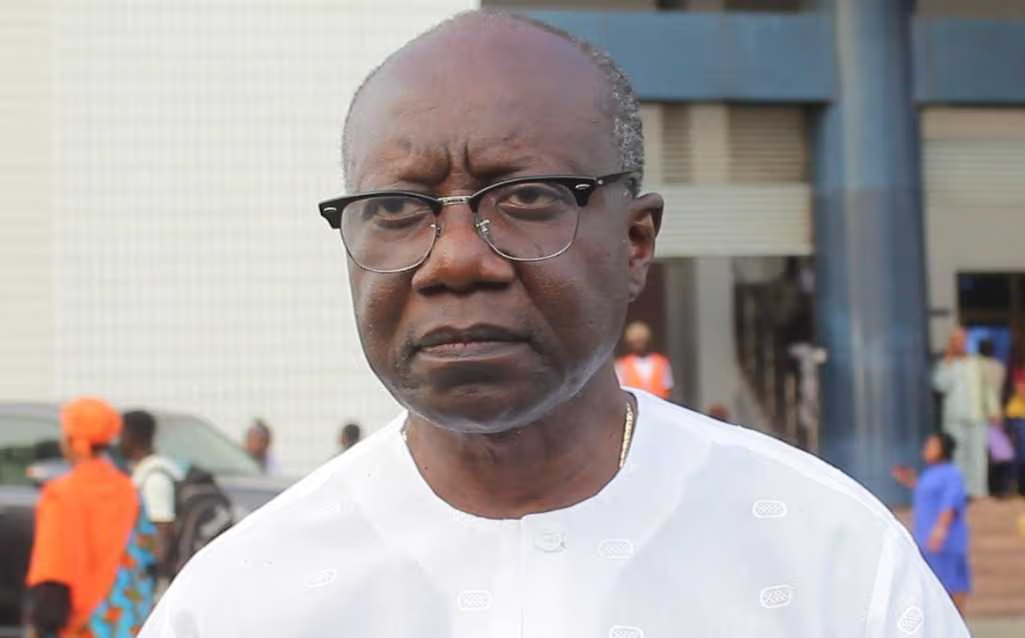
Legal practitioner and policy expert Austin Kwabena Brako-Powers has expressed that the concerns articulated by former Finance Minister Ken Ofori-Atta regarding the possibility of receiving a fair trial in Ghana pertain more to the overarching legal framework than to the judiciary itself.
Mr. Brako-Powers indicated that Ofori-Atta’s opposition to extradition should be viewed in light of his concerns about the potential developments during the investigative and prosecutorial phases of the case.
During an appearance on 3FM’s Sunrise show on Monday, March 16, 2026, he clarified that the former minister and his legal representatives are not fundamentally disputing the competence or authority of the courts; rather, they are apprehensive about the procedural aspects leading to any prospective trial.
Mr. Brako-Powers emphasized that the notion of a fair trial extends beyond the courtroom and commences from the initial stages of investigation.
“A fair trial does not commence when an accused individual is brought before a court,” he stated. “It actually initiates during the investigative phase, and if the preliminary stages are not managed appropriately, it can lead to suspicions of political persecution.”
The AI researcher and development communication specialist further noted that once an accused individual begins to perceive the process as potentially politically motivated, they are inclined to adopt a defensive stance and utilize all available legal avenues for their protection.
The attorney also criticized the prosecutorial approach taken by Kissi Agyebeng, the Special Prosecutor, and Attorney-General Dominic Ayine, contending that their methodology has failed to instill confidence in Ofori-Atta, his legal team, or segments of the Ghanaian populace.
He asserted that the demeanor and behavior of the prosecution can profoundly affect whether an accused individual feels they will be treated fairly within the judicial system.
Mr. Brako-Powers additionally remarked on the condition of the judiciary in Ghana, observing that while it is constitutionally intended to be independent, its independence often seems more robust in theory than in actual practice.
He recognized that while Ghana’s judiciary has achieved significant advancements over the years, it still cannot be regarded as one of the most robust judicial systems in Africa.
Mr. Brako-Powers further noted that U.S. authorities, when evaluating extradition requests, generally assess whether the person sought might encounter political persecution in the country making the request.
Consequently, he is of the opinion that Ghana’s prosecuting authorities may encounter a challenging legal hurdle in the current extradition proceedings.


