

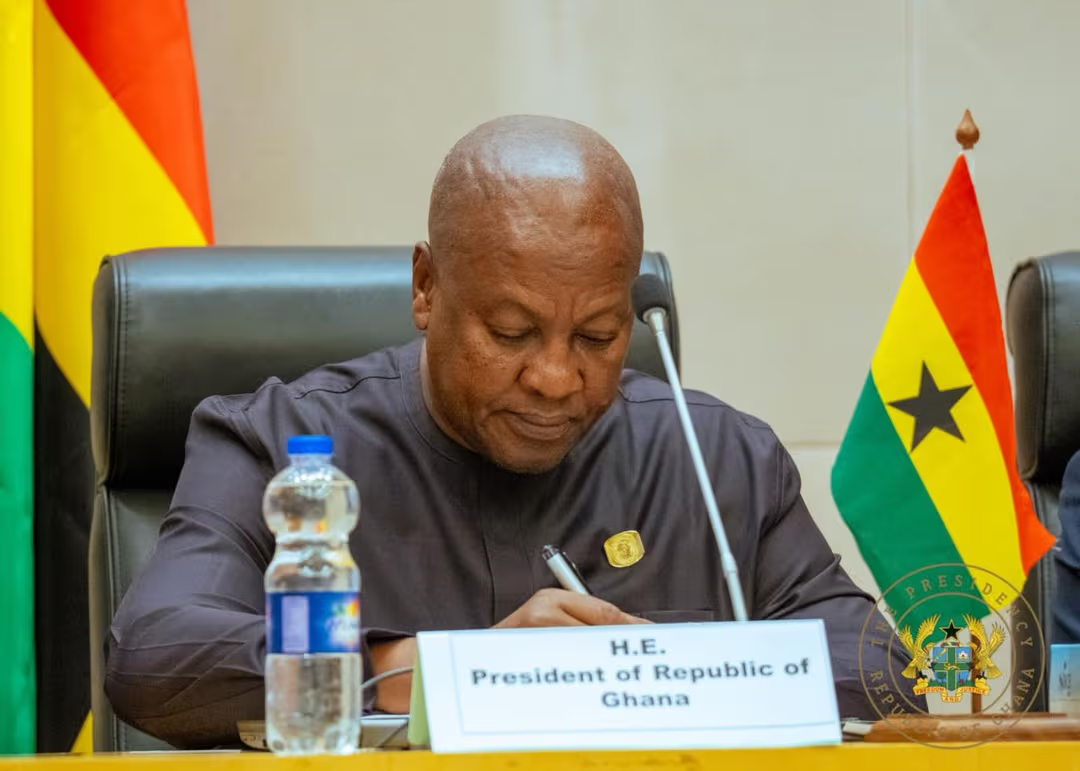
President John Dramani Mahama has informed African leaders that reparatory justice will not be given to them. He emphasized that, similar to independence, it must be achieved through unity and determination.
President Mahama stated that he has begun the process of presenting a resolution at the General Assembly in March of this year, which seeks global acknowledgment of the Transatlantic Slave Trade as the most severe crime against humanity.
“Reparatory justice will not be given to us. Just like independence, it must be achieved through unity and determination.
“In my report to the Assembly of the African Union Heads of State this morning regarding the advancement of justice and the payment of reparations to Africans and individuals of African descent, I noted that 2025, designated as the African Union Year of Justice through Reparations, represents a pivotal moment,” he posted on Facebook following his address at the AU Summit Press Conference on Reparations.
He continued, “We have formed the AU Coordination Team and Committee of Experts on Reparations, engaged with global institutions from the UN to UNESCO, led discussions at significant international forums across four continents, and redefined reparations as forward-looking tools for justice and equity.
“However, our efforts are far from complete. I urged all Member States to enhance our institutions, create national reparations commissions, and collaborate with the global community to secure apologies, restitution, and binding agreements.”
Foreign Affairs Minister Samuel Okudzeto Ablakwah congratulated President Mahama and Ghana for obtaining the unanimous support of all African Union member states for President Mahama’s initiative to present a resolution at the UN declaring the transatlantic slave trade as the most serious crime against humanity and to demand reparations, including the return of stolen artifacts.
President Mahama is anticipated to achieve a comparable endorsement at the 50th Conference of Heads of Government of the Caribbean Community (CARICOM) Summit scheduled for February 24, 2026.
The resolution is set to be presented at the UN General Assembly on March 25, 2026.
In a post on Facebook, Mr. Anblakwa praised the “dedicated colleagues at the Ministry of Foreign Affairs and our coalition of global experts and activists for this historic milestone.”
He added, “Inspirational unity for truth and justice as we commit to resetting the development paradigm of our continent with a new leadership approach that generates genuine opportunities and wealth for our people.”
Previously, the Government of the Republic of Ghana, acting as the African Union Champion for Reparations, hosted the African Union Committee of Experts on Reparations (AUCER) and the African Union Legal Experts on Reparations (AULER) for a two-day joint Bureau meeting, aimed at enhancing coordination to promote the continent’s reparations agenda.
During his keynote address at the meeting’s opening session, the Minister for Foreign Affairs, Samuel Okudzeto Ablakwa, reaffirmed Ghana’s commitment to fulfilling its role as Champion in accordance with the Union’s mission to advance justice for Africans and people of African descent through structured, credible, and coordinated multilateral engagement.
He emphasized the historical importance of Ghana as a significant site of memory in the transatlantic slave trade, noting that many Africans who were forcibly taken from the continent passed through forts and castles along Ghana’s coast.
He pointed out Ghana’s enduring role in Pan-African solidarity and stressed that the pursuit of reparations by Africa is fundamentally a matter of justice. He characterized the transatlantic slave trade as a prolonged, exploitative economic system, highlighting the necessity for restitution and referencing instances where reparations have been granted for historical injustices.
He advocated for ongoing collaboration, a clear sense of purpose, and strategic involvement to guarantee that Africa’s stance is effectively represented within the multilateral framework and that the matter of reparations is not regarded as a secondary issue.
Representing the Chairperson of the African Union Commission, the Director of the Citizens and Diaspora Directorate (CIDO), Ambassador Amr Aljowaily, remarked that the joint meeting was convened in accordance with African Union Assembly Decision 884, which elevated reparations from a mere moral appeal to a structured continental action plan. He clarified that this decision identified reparations as a flagship initiative of the Union and established specialized expert mechanisms to facilitate its execution.
Ambassador Aljowaily highlighted that the meeting marked a significant advancement in solidifying Africa’s institutional framework regarding reparations, aimed at enhancing collaboration among technical and legal experts to foster informed policy, diplomatic, and legal efforts at both continental and global scales.
He pointed out that the continent’s pursuit of reparations aligns with aspirations 3, 5, and 7 of Agenda 2063. He expressed gratitude to the Government of Ghana for hosting the meeting and for its leadership in promoting the African Union’s reparations agenda.
In his address, the Acting Chair of the African Union Legal Experts on Reparations (AULER), Advocate Kingston Magaya, stressed that the pursuit of reparations is a legal necessity rooted in international law, justice, and human dignity.
He remarked that the transatlantic slave trade, colonialism, and associated practices continue to have lasting social, economic, and cultural impacts on Africans and individuals of African descent. Advocate Magaya underscored the importance of AULER in offering legal guidance to support Africa’s reparations agenda, including the articulation of legal principles and strategies that align with established international norms.
norms, while collaborating closely with other African Union expert mechanisms to promote a unified continental stance.
In her remarks, the Chair of the African Union Committee of Experts on Reparations (AUCER), Dr. Jane Mufamadi, emphasized the pivotal role of the Committee in formulating a shared African perspective on reparations and a coherent action plan to steer continental initiatives.
Dr. Mufamadi stressed the significance of inclusive participation, knowledge exchange, and strategic partnerships to ensure that Africa’s reparations agenda addresses both historical contexts and current challenges, while fostering a cohesive and credible continental representation in global discussions.
The two-day conference is anticipated to shape the forthcoming phase of continental involvement in reparations, including synchronized strategies to enhance Africa’s voice regarding issues of historical injustice on the international stage.


